What is a club management ecosystem for racquet sports?
What is a club management ecosystem for racquet sports?

A club management ecosystem for racquet sports is one digital platform that runs your entire club: court bookings, memberships, billing, events, and communications. All of it. Not five apps duct-taped together. One system.
That's it. That's the whole concept. Everything after this is detail.
But the detail matters, because "ecosystem" gets thrown around by every software vendor with a login page and a calendar widget. So let's be precise about what actually qualifies, what it fixes, and what happens to clubs that keep bolting spreadsheets onto email chains and calling it a system.
A real club management ecosystem consolidates every core function of a tennis, padel, or pickleball club into one platform. Done right, it cuts admin time, lifts court utilization, and makes members feel like they belong somewhere organized. Generic, one-size-fits-all software rarely gets there. Sport-specific, bespoke systems like Six-love usually do.
What's Actually Inside One of These Systems
Here's the part most "ecosystem" marketing skips.
The phrase itself isn't an industry technical term, it's shorthand. The formal name is an integrated club management system. Knowing the components lets you tell the difference between a genuine ecosystem and three tools wearing a trench coat.
A real one includes:
Membership management — profiles, tiers, renewal automation, communication history, all in one record. Members update their own details instead of emailing your front desk.
Court booking and scheduling — sport-specific rules for tennis, padel, and pickleball. Peak-hour pricing, session lengths, guest policies. Conflicts get flagged before they happen, not after someone's standing on a court that's double-booked.
Payment processing and financial tracking — automated dues, invoices, reconciliation. You see who owes what without opening six spreadsheets.
Event management — tournaments, lessons, socials, waitlists. Notifications fire automatically when a spot opens.
Reporting and analytics — utilization rates, revenue trends, retention, attendance. Real numbers instead of a guess based on how busy Tuesday felt.
Role-based access and security — staff see what their job requires. Nothing more. Member data stays protected without slowing anyone down.
I've done it myself. I organised a match with multiple players via WhatsApp. I didn't have everyone's number, so relied on my messages being forwarded. I manually booked with the club admin desk. When we turned up, our booking wasn't there. Human error. Actually, this time my mistake. Something was miscommunicated along the way, and we turned up on the wrong day. When something is organised manually, it's easy to make mistakes, even if you are as organised as I usually am.
None of that is new information on its own. What's new is doing it in one connected system instead of five disconnected ones. That single change is what actually separates an ecosystem from a pile of apps.
How Much Time Does This Actually Save You?

Operational efficiency is the fastest, most measurable payoff. Not engagement. Not branding. Time.
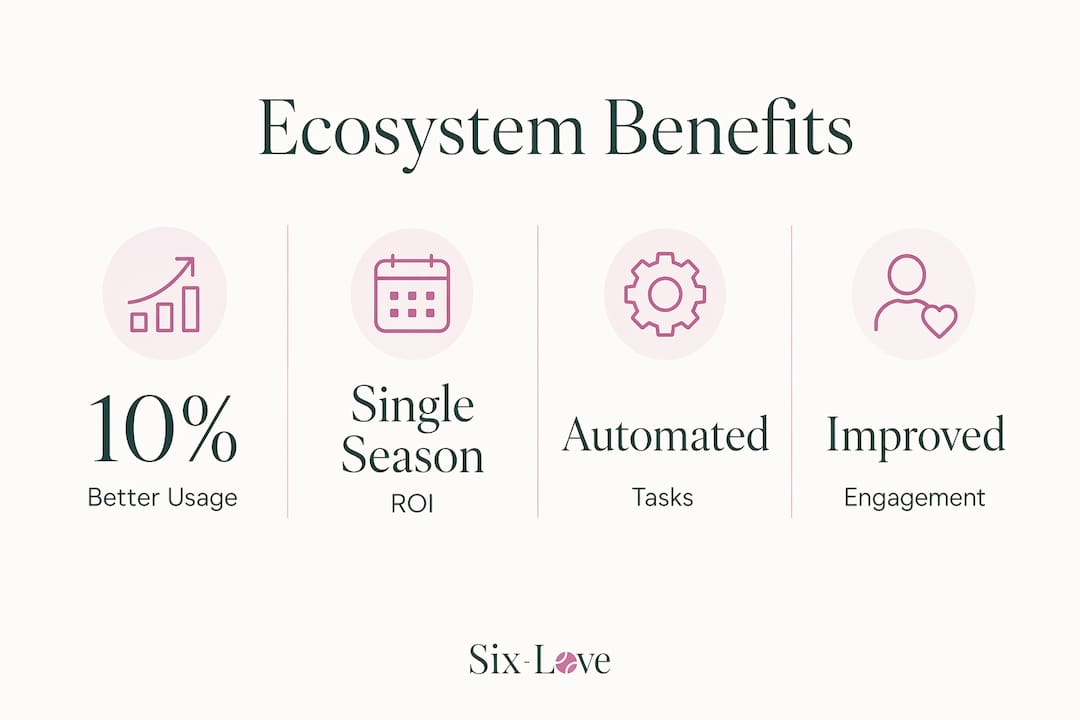
Clubs that consolidate operations into a unified ecosystem see facility utilization climb 8 to 10 percent and administrative time drop by up to 30 percent. Run four padel courts on a busy weekend and that utilization bump alone can mean real extra revenue, without building a single new court.
We saved a client of a small local club in Ireland over 30 hours of admin each week, just by introducing our most basic system. It freed up time for the admin to work on things to actually improve their club, rather than just managing bookings.
Automation is doing the heavy lifting here. Renewals trigger before expiry. Payment reminders go out without a human touching send. Booking confirmations and cancellation alerts land instantly. Fewer errors. Fewer missed payments. Fewer double bookings.
ROI often shows up within a single season, once dues collection and unpaid-member tracking are automated. For clubs running on tight seasonal budgets, that speed matters more than any feature list.
Pro Tip: Map every manual task your staff does in a normal week. Anything repeated more than twice deserves automation. If a platform can't handle that without custom development, it isn't a real ecosystem, it's a spreadsheet with a nicer font.
And here's the thing nobody puts on the pricing page: staff morale improves noticeably once your team stops correcting data errors and chasing overdue invoices. That time goes back into actual member interaction. The stuff that builds loyalty. Not paperwork.
Why Does Member Engagement Actually Improve?
Engagement rises when belonging to your club feels consistent. Personal. Frictionless. A patchwork of tools can't deliver that no matter how good each individual piece is.
Five things members notice immediately:
Faster, consistent communication. Court reminders, tournament announcements, renewal prompts — all automated, all on time. Nothing falls through because someone forgot to hit send.
Simpler booking and payment. One portal. Book a pickleball court, pay dues, register for a social — same login, same flow. Fewer steps means fewer people giving up halfway through.
Transparent access to their own data. Members see their booking history, payments, and upcoming events without calling reception. That transparency, quietly, builds trust.
Better event turnout. Clubs report a 2 to 3 percent lift in event performance from better scheduling and financial tracking inside integrated systems. Automated waitlists fill events that used to run at half capacity.
Reliability equals trust. Modern platforms move club systems from passive filing cabinets to active tools that actually help. When a booking always works and an invoice is always correct, members stop noticing the system — which is exactly the point.
Pro Tip: Send a short monthly summary to members — court usage, upcoming events, membership status. Most systems generate this automatically. Members who see their own activity data renew at higher rates. Every time.
Bespoke White-Label Ecosystems vs. Generic Club Software
Generic club software is built for the widest possible market. That's its whole problem.
A platform designed for golf clubs, gyms, and community centers rarely handles the booking logic that tennis, padel, and pickleball clubs actually need. Bespoke platforms offer flexible billing, tiered memberships, and sport-specific booking rules generic tools simply don't have. Padel clubs need four-player court enforcement, partner matching, peak-hour surcharges. Generic software forces a workaround. Workarounds frustrate everyone, staff and members alike.
One of our newer clients in Spain had been relying heavily on Playtomic. But when they wanted to organise a tournament, despite getting bookings for the event via the app, they then lost lots of the bookings just a few days before, as playtomic was actively advertising a competing event in the areas to the clubs competitors. The result was a loss-making event, and unhappy players, as the tournament was only 1/2 full. The event manager could not stop people from leaving as they did not have enough control of how registrations and cancellations were dealt with. At six-love we ensure all our clubs have full control of every event, registration and cancellation rules and of course, we never advertise your competitors to your players.
Here's how the two approaches stack up on what actually matters to racquet sports club managers:
Sport-specific booking rules. Bespoke: built in for tennis, padel, pickleball. Generic: manual workarounds every time.
Club branding. Bespoke: fully customizable interface and member portal. Generic: fixed templates, limited branding.
Membership tier flexibility. Bespoke: tailored to your club's actual structure. Generic: standard tiers only.
Integration with existing systems. Bespoke: designed for flexible connection. Generic: often locked to a short approved list.
Member experience. Bespoke: consistent with your club's identity. Generic: generic. (Yes, that's circular. That's also the point.)
Vendor support. Bespoke: sport-specific expertise. Generic: broad but shallow.
Six-love sits firmly in the bespoke category. White-label means your members see your branding at every touchpoint — not a third-party logo stamped over your court reservations. That consistency reinforces identity, and identity is what keeps people renewing year after year.
How to Actually Run a Club Ecosystem After You've Bought One
Picking the platform is the easy part. Clubs that get the most value treat implementation as ongoing, not a one-and-done rollout.
Audit your needs before you commit. List every operational pain point — booking conflicts, late payment chasing, whatever it is — and match those to specific features. Don't buy off a demo alone.
Invest in staff onboarding. A system your team doesn't trust delivers none of its promised value. Give training time before go-live. Pick one internal champion who becomes the go-to expert.
Onboard members deliberately. Send a clear guide to the new portal, payment process, and profile features. Offer a short walk-through for members less comfortable with digital tools.
Review performance data monthly. Utilization, renewal rates, event attendance — set a review date, act on what you see. Don't let the dashboard become wallpaper.
Use vendor support proactively. A question answered in ten minutes saves hours of internal troubleshooting. Use the onboarding support and knowledge base you're already paying for.
Build a feedback loop. Ask members and staff what's working, at least quarterly. Software only delivers value if it matches how your club actually runs — not how it ran on paper during the sales call.
Clubs that treat the ecosystem as a living system — not a fixed installation — consistently outperform the ones that set it up and walk away.
Key Takeaways
A club management ecosystem only delivers full value when it actually integrates bookings, billing, membership, and communications — built for the specific demands of tennis, padel, and pickleball clubs, not adapted from something built for gyms.
Ecosystem definition: One unified platform connecting bookings, billing, membership, and communications for racquet sports clubs.
Operational efficiency: Cuts admin time up to 30 percent, lifts facility utilization 8 to 10 percent.
Member engagement: Automated communication, transparent portals, and reliable booking build long-term trust.
Bespoke vs. generic: Sport-specific platforms handle padel, tennis, and pickleball rules generic software can't.
Implementation success: Ongoing training, monthly data reviews, and member feedback loops decide the long-term outcome.
The View From the Court: Why Ecosystems Stopped Being Optional
I've spent years watching racquet sports clubs try to patch together a workable system out of booking apps, accounting software, and email newsletters. Honestly? That approach costs more than it saves. Staff burn hours every week reconciling data between tools that were never designed to talk to each other. Members notice the inconsistency — even when they can't name what's bothering them.
What strikes me most about where things stand right now is how fast the gap is widening. Clubs running a real integrated platform aren't just more efficient. They're making better decisions, because they have actual data. They know which courts sit empty on Tuesday mornings. They know exactly which membership tier is bleeding members. They act on that. They don't guess.
AI and analytics baked into leading platforms are accelerating that gap. Predictive scheduling, automated revenue reporting, personalized member outreach — none of that is exclusive to big private clubs anymore. Any tennis, padel, or pickleball club willing to move past spreadsheets can have it.
At one of our largest clubs in the UK, a tennis , padel and pickleball venue, they struggled with multiple software used to run the club. from WhatsApp groups for coaches and social mix-ins to 3rd part booking apps and then separate accounting systems. Once we fully integrated Six-Love, everything was consolidated. Everything worked together as it was designed that way. The club no longer needed to check a WhatsApp group for attendance, then a separate system for payments, and finally a court scheduling system for managing the bookings. It was all in one place, and because it all works together, the admin could see the whole picture on one screen.
Six-love clients have reported an average of 22 percent revenue increase within two months of going live, driven by fewer booking conflicts and stronger member engagement, not by raising prices.
My strongest recommendation: don't pick a platform because it's cheap or familiar. Pick it because it was built for racquet sports and can grow with your club. A bespoke, white-label ecosystem that reflects your club's identity and handles your sport's actual rules will beat a generic system every time — regardless of how long the feature list is on someone's pricing page.
The clubs still thriving five years from now will be the ones building a culture around this. Reviewing data. Acting on feedback. Training their teams instead of just installing software and hoping.
— Darren
How Six-love supports racquet sports club managers
Six-love is built specifically for tennis, padel, and pickleball clubs that need more than a generic booking tool.
The platform’s white-label design means your members interact with your brand at every touchpoint, from court reservations to membership renewals. Six-love clients have reported a 22% revenue increase within two months of going live, driven by reduced booking conflicts and improved member engagement. Whether you manage a padel booking system, a tennis court booking operation, or a pickleball scheduling programme, Six-love adapts to your club’s structure rather than forcing your club to adapt to the software. Explore the full range of club management tools or visit Six-love to see how a bespoke ecosystem fits your club’s needs.
FAQ
What is a club management ecosystem in simple terms?
A club management ecosystem is a single digital platform that connects court bookings, membership records, payments, and communications for a racquet sports club. It replaces disconnected tools with one integrated system.
How does a club management system benefit tennis, padel, and pickleball clubs specifically?
Sport-specific systems handle booking rules unique to each racquet sport, such as four-player padel courts or mixed-ability pickleball sessions, which generic platforms cannot manage without workarounds.
How long does it take to see a return on investment from a club management ecosystem?
ROI is often realised within a single season by automating dues collection and tracking unpaid memberships, reducing the revenue lost to manual billing processes.
What features of club management software matter most for member engagement?
Automated communications, a self-service member portal, and transparent booking and payment records are the features that most directly improve member satisfaction and renewal rates.
Is a bespoke white-label ecosystem worth the investment for smaller racquet clubs?
Yes. Bespoke platforms offer flexible billing cycles and sport-specific booking rules that generic systems lack, and the efficiency gains typically offset the cost within the first season of operation.
Recommended
Frequently Asked Questions
What is a club management ecosystem in simple terms?
A club management ecosystem is a single digital platform that connects court bookings, membership records, payments, and communications for a racquet sports club. It replaces disconnected tools with one integrated system.
How does a club management system benefit tennis, padel, and pickleball clubs specifically?
Sport-specific systems handle booking rules unique to each racquet sport, such as four-player padel courts or mixed-ability pickleball sessions, which generic platforms cannot manage without workarounds.
How long does it take to see a return on investment from a club management ecosystem?
ROI is often realised within a single season by automating dues collection and tracking unpaid memberships, reducing the revenue lost to manual billing processes.
What features of club management software matter most for member engagement?
Automated communications, a self-service member portal, and transparent booking and payment records are the features that most directly improve member satisfaction and renewal rates.
Is a bespoke white-label ecosystem worth the investment for smaller racquet clubs?
Yes. Bespoke platforms offer flexible billing cycles and sport-specific booking rules that generic systems lack, and the efficiency gains typically offset the cost within the first season of operation.