Why tennis clubs need waitlist management in 2026
Why tennis clubs need waitlist management in 2026: An Operator's Guide to Maximizing Court Yield

Let's look at a harsh reality. Empty courts kill revenue. Dead space during peak hours is a financial leak you can never get back. Yet, most high-volume racquet sports complexes still handle fully booked peak slots with absolute passive resignation. A member checks the app, sees a full grid at 6:00 PM, and simply closes the app.
That is a dropped transaction. Period.
If your facility lacks an active, automated backup plan for when courts fill up, you are leaving thousands on the table. You are also actively annoying your most active players. They want to play. You have the real estate. But a rigid, static scheduling system acts as a barrier instead of a bridge.
Look, managing multi-court facilities means treating time like perishable inventory. When someone cancels a prime evening padel or tennis slot with only two hours of notice, a manual switchboard simply cannot scramble fast enough to save that court fee.
I have worked with many tennis, padel and pickleball admin staff and club managers. Often, they found that most of their time was taken up by scheduling, rescheduling and more scheduling. Between phone calls, WhatsApp groups and booking apps, nothing was connected, and a few things were truly automated or optimised. I experienced how repeatedly rescheduled bookings ended in cancellations and frustration.
Fixing this layout bottleneck requires shifting from static booking grids to active queue automation. Systems like the USTA's Programming Waiting Lists framework prove that managing customer demand via structured queues is a core retention mechanism. It keeps players engaged even when the facility is technically at maximum capacity. While helpful, they very often lack the powerful features that keep members engaged and reduce staff workload.

The Operational Nightmare of Manual Waitlists
Amateur operations try to solve this with paper clipboards at the front desk or chaotic WhatsApp group chats. What a mess.
Think about the workflow strain on your club manager. A prime padel court drops out. The front desk agent pulls out a notebook. They call the first person on the handwritten list. No answer. Voicemail. They call the second person. That person needs twenty minutes to check with their partner. Meanwhile, the clock is ticking, the court remains cold, and your yield drops.
Then there is the structural integrity of your club data. If you have no automated tracking, you cannot measure true demand. How many players wanted a court at 7:00 PM on Tuesday but walked away completely empty-handed? You don't know. Without hard metrics, you are flying completely blind when planning academy schedules, setting seasonal tier structures, or considering physical facility expansions.
In a recent analysis that we completed for a popular padel and tennis club, we estimated time savings of over 90 hours per week, after implementing our tennis and padel club booking and management software. Those savings came from fewer phone calls, automated rescheduling, email triggers and reduced dependence for users to enquire about available courts at the club.
When cancellations stay unfilled, you don't just lose the immediate court hire fee. You lose the secondary revenue. No pro-shop sales. No post-match drinks at the bar. No clinic sign-ups. The financial slippage compounds across your entire business ecosystem.
Core Rules for Automated Queue Architecture
You cannot fix a specialized racquet sports workflow using a generic corporate booking widget or standard restaurant reservation engine. Those tools do not understand the interlocking nature of sports infrastructure. Your system needs an architecture tailored directly to club logistics, focusing on three major technical pillars.
Real-Time Priority Automation
When a prime slot opens up, the platform must instantly scan an active digital waitlist database. It has to automatically alert the next eligible player in line based on clear, custom club rules. No manual intervention from desk staff. The system does the heavy lifting, sending a direct push notification with a strict expiration timer to keep the line moving.
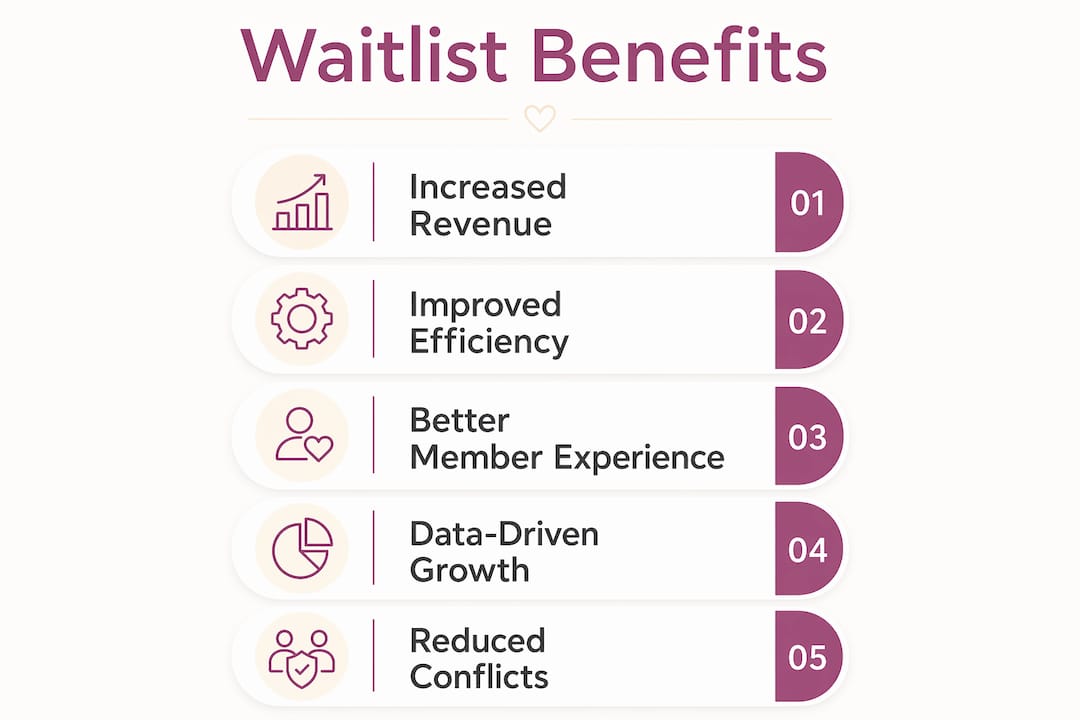
Pro Tip: Set a clear response window for waitlist invitations, typically 24 to 48 hours. A tight window keeps the queue moving and prevents spots from sitting empty while members deliberate.
Skill and Level Gatekeeping
A premier sports management system must look deeper than a basic timestamp. If an advanced player drops out of an internal competitive challenge match, dropping a beginner into that slot ruins the game for the remaining three players. True queue automation must integrate seamlessly with player skill filters. This ensures only properly rated members receive the targeted slot offer.
When we were contacted to demonstrate our system for pickleball club management, we listened to their needs and found multiple pain points. One was groups and waiting lists. Often, players cancelled, resulting in missed spaces and extra work for the admin. Our group scheduling feature automatically assigns courts and coaches (when needed). It lets players sign up and pay for their slot, but when the group is full, a waiting list is automatically created. This drastically reduced administrative tasks and helped ensure that everyone knows when free spots open up.
Frictionless Upfront Payment Commits
Capturing player intent means securing the financial commitment upfront. Your platform should leverage modern payment infrastructure like Stripe directly inside the native mobile app. When a player joins a high-demand waitlist block, the engine checks their card authority or package credit account immediately. The second they accept the open slot, the checkout processes seamlessly with zero administrative friction.
Shifting From Legacy Layouts to Modern Flow
Let's break down the two operational paths clearly.
The Legacy Flow: A prime evening court slot gets canceled. The front desk agent texts three different member groups. Two hours later, a player replies, but their partner can't make it. The court stays dark. The club swallows the loss.
The Modern Flow: A player drops a 6:00 PM padel slot via their app. The Six Love club features engine instantly triggers a time-sensitive notification to the top three matching players on the waitlist. A player accepts the opening with two taps, the integrated card checkout processes, and the court sheet updates globally across all administrative screens in seconds.
The Difference Between Standard Calendars and Specialized Software
Most club operators try to cut corners by running basic retail platforms or general register setups like XEPOS Tennis and Padel Centre Software. While those tools are perfectly fine for ringing up an over-the-counter racket sale or tracking a basic register till, they are entirely standalone devices. They cannot map complex, codependent sports infrastructure.
Similarly, trying to patch together basic reservation lines using generic open-source code scripts like the CourtPin repository on GitHub leaves your business vulnerable. Those scripts lack the robust, enterprise-grade engineering required to prevent double-bookings, process complex recurring multi-coach academy packages, or handle fluid, high-volume member queues.
Even off-the-shelf options like Anolla Tennis Software frequently fail to bridge the operational gap between casual social court hire, professional coaching rosters, and automated capacity queues. You wind up running your club using a fragmented mess of disconnected third-party software tools, separate spreadsheets, and ad-hoc WhatsApp groups right alongside the system just to keep things from breaking down. That completely defeats the entire point of digital transformation.
When we worked with a club using Playtomic, they were suffering from a disconnection between their internal systems and the limitations of their booking application. Players were using WhatsApp groups and having to jump through multiple hoops to make a booking. When we introduced our customised system, everything could be handled in one place. The chat, the booking , the payments and the reconciliation for the club. Everything works together, eliminating the need for multiple moving parts. This provided a better booking flow for the users and easier administration for the management team.
A dedicated racquet sports platform does far more than just log a reservation on a line. It treats your court real estate, coach rosters, player ratings, and financial ledgers as one single, interlocking engine.
Strategic Action Items for Facility Directors
Transitioning your tennis, padel, or pickleball complex away from reactive management requires a step-by-step operational rollout. Do not change everything overnight. Introduce features progressively so your staff and membership can adapt naturally.
Kill the Back-and-Forth: Move your community entirely over to a live digital interface where open court availability updates globally in real-time across all member devices.
Stop the No-Shows: Enforce mandatory card authorization, upfront package credit validation, or strict cancellation windows at the exact moment of booking to safeguard your club's prime evening yield.
Connect Your Assets: Make sure your underlying coaching rosters speak directly to your physical court sheets. Two separate coaches should never arrive to teach private lessons on the exact same court tile at the exact same hour.
Launch the Queue in Stages: Start by turning on automated waitlists for casual social matches during your busiest weekend morning blocks. Once your desk team is fully comfortable with the dashboard metrics, layer in queue triggers for high-demand group coaching clinics, competitive team leagues, and seasonal academy blocks.
Six Love’s Dedicated Management Solutions
Premier sports complexes require an ecosystem where recreational play, elite academy training, drop-in social clinics, and competitive club tournaments all run concurrently without friction.
Six Love is built explicitly for this complex environment. Our platform handles multi-coach synchronization, enforces ironclad court conflict prevention, and delivers deep operational analytics designed to help club directors squeeze maximum revenue out of every square meter of their facility.
Facilities migrating to our architecture experience an average 22 percent increase in total court utilization within the first 60 days of implementation, gaining complete operational visibility within a beautiful interface tailored precisely to your specific club rules.
[Get in touch with the Six Love team today to view a customized operational setup of your club’s new scheduling engine.]
Recommended
Frequently Asked Questions
What is waitlist management in a tennis club?
Waitlist management is the process of tracking and communicating with members or prospective members who are queued for a court, programme, or membership that is currently at capacity. It governs how vacancies are filled and in what order.
How does an automated waitlist work for tennis bookings?
When a session or membership tier reaches full capacity, the system activates the waitlist automatically. If a cancellation occurs, the top-ranked waitlisted member receives an invitation to take the spot, typically via email, on a first-come, first-served basis.
Why does transparency matter on a tennis club waitlist?
Inconsistent communication erodes trust and reduces the perceived value of club membership. Members who receive clear, regular updates about their waitlist position are significantly less likely to resign before a vacancy opens.
Can waitlist data help a club grow its programme offering?
Yes. Waitlists track demand variations by time, day, and programme type. A consistently long queue for a specific session is direct evidence that adding capacity or a new programme will be commercially viable.
What happens if a returning member does not renew on time?
Returning members who fail to renew typically lose their priority status and must rejoin the general waitlist. This policy encourages timely renewals and reduces the administrative effort required to manage lapsed memberships.