Integrating payments into club software: a practical guide

For most UK racquet clubs, the right route is an embedded payment integration with tokenised card storage, connected to your club management system via webhooks, and backed by a PCI DSS Level 1 provider. That setup automates membership billing, satisfies Strong Customer Authentication (SCA) requirements, and keeps your PCI scope to a minimum.
Start here:
- Technical first step: Create a sandbox account with your chosen payment service provider (PSP), generate API keys and webhook credentials, and run test transactions before touching your live environment.
- Operational first step: Brief your finance and membership teams on the new billing flow, agree a go-live date, and schedule a sandbox walkthrough together.
Key takeaways
Embedded, tokenised payment integrations connected via webhooks give UK racquet clubs the best balance of automation, security, and PCI compliance.
| Point | Details |
|---|---|
| Choose the right integration type | Start with hosted checkout for speed; move to embedded/API once membership volumes grow. |
| Automate recurring billing | Map membership plans to PSP subscription objects and enable card updater to cut failed renewals. |
| Minimise PCI scope | Use PSP-hosted or Elements-style flows and never store raw card data in your own system. |
| Test before going live | Run sandbox tests covering declines, webhooks, and a full subscription lifecycle before switching to live keys. |
| Six-love for racquet clubs | Six-love’s white-label platform includes payment integrations, reconciliation, and member portal billing history out of the box. |
Table of Contents
- Which payment provider suits your club’s needs?
- Hosted checkout, embedded API, or point-of-sale: which fits your club?
- Recurring billing, subscriptions and failed-payment recovery
- How do you keep member payment data secure and compliant?
- Refunds, chargebacks and bookkeeping
- Sandbox testing and go-live checklist
- How Six-love handles payments for racquet clubs
- The part most clubs underestimate
- Six-love gives racquet clubs a faster route to automated billing
- Sources
- FAQ
Which payment provider suits your club’s needs?
Integrating payments into club software is not a one-size-fits-all decision. The right provider depends on your club’s size, technical capacity, and billing model.
Stripe is the strongest all-rounder for clubs with a developer resource. Its Checkout Sessions and Payment Element reduce custom code significantly, and its card updater feature automatically refreshes stored card details to cut subscription declines. It handles SCA natively and supports off-session charges for recurring memberships. For clubs running monthly or annual plans, Stripe’s subscription API is mature and well-documented.
Square suits clubs that need both online payments and a physical point-of-sale terminal at reception or a pro shop. Its hosted checkout pages lower implementation effort, while the Web Payments SDK and In-App Payments SDK allow deeper tokenisation when you need it. Square’s API also maps clearly to one-time payments, subscriptions, and invoices.
Mollie is worth considering for clubs that want a single provider covering cards, digital wallets, and Direct Debit in one integration. Its club billing automation examples include failed-payment tracking and front-desk contactless sales, which maps directly to how most membership clubs operate.
GoCardless is the specialist choice for Direct Debit. If your members prefer paying by bank mandate rather than card, GoCardless handles UK Direct Debit and SEPA mandates with built-in retry logic. Transaction costs are typically lower than card processing, which matters at volume.
PayPal remains useful where members expect to pay via their PayPal balance or linked accounts. Its JavaScript SDK and server-side order capture make it straightforward to add as a secondary payment method alongside a primary card processor.
Six-love offers bespoke, white-label payment integrations built specifically for racquet sports clubs, with reconciliation and member portal features included. For clubs that want payment processing configured within their court reservation and club management platform rather than assembled from scratch, it removes the integration overhead entirely.
Questions to ask any provider before signing up:
- Does it support SCA and 3D Secure 2 for UK card payments?
- Can it tokenise cards and run off-session charges for recurring memberships?
- Does it offer a card account updater to reduce failed renewals?
- How does it handle disputes and chargebacks, and what evidence does it accept?
- Are webhooks signed and reliable, with documented retry behaviour?
- Does it support UK Direct Debit or SEPA mandates?
- Is it available in the UK with GBP settlement?
Hosted checkout, embedded API, or point-of-sale: which fits your club?
The three main integration approaches each carry different trade-offs in effort, flexibility, and PCI scope.
Hosted checkout
The PSP serves the payment page from its own domain. Your club software redirects the member there, the payment is processed, and the member returns to your site with a success or failure status. Implementation is fast, typically a few hours of developer time, and your PCI scope drops to SAQ A because you never handle card data directly. The trade-off is a less polished member experience: the payment page looks like the PSP’s brand, not yours.
This approach suits smaller clubs, volunteer-run organisations, or any club launching quickly without a dedicated developer.
Embedded / API integration
Card fields are rendered inside your club software using the PSP’s JavaScript elements or SDK. Card data is tokenised in the browser and sent directly to the PSP; your server never sees raw card numbers. This keeps PCI scope manageable (SAQ A-EP) while giving members a fully branded experience. Webhooks then notify your system of payment outcomes in real time.
Stripe’s client_secret flows and Elements handle SCA challenges and saved-card flows for off-session charges, which is exactly what recurring membership billing requires. This is the right approach for clubs with a developer resource and more than a few hundred members.
Point-of-sale / in-person
Clubs with a reception desk, pro shop, or court-side sales need a card reader. Square’s hardware integrates with its online APIs, so transactions from the desk and from the member portal land in the same reporting dashboard. Mollie also supports contactless front-desk sales within the same account.
Pro Tip: Start with a hosted checkout to get payments live quickly, then phase to an embedded integration once membership volumes justify the development investment. You can run both in parallel during the transition.
Recurring billing, subscriptions and failed-payment recovery
Membership clubs run on predictable recurring revenue, so getting subscription billing right is worth the effort upfront.
Most clubs need at least three plan types: monthly individual, annual individual, and family or group plans. Map each to a separate product and price object in your PSP, then link them to member records in your club system. When a member upgrades or downgrades, update the subscription object rather than cancelling and recreating it, to preserve billing history.
Off-session charges, where you charge a stored card without the member present, require explicit consent under UK SCA rules. Collect that consent during the initial sign-up flow, flag it clearly in your terms, and store the PSP’s payment method ID against the member record. Stripe’s automatic_payment_methods and card updater features then handle the mechanics of keeping stored cards current.
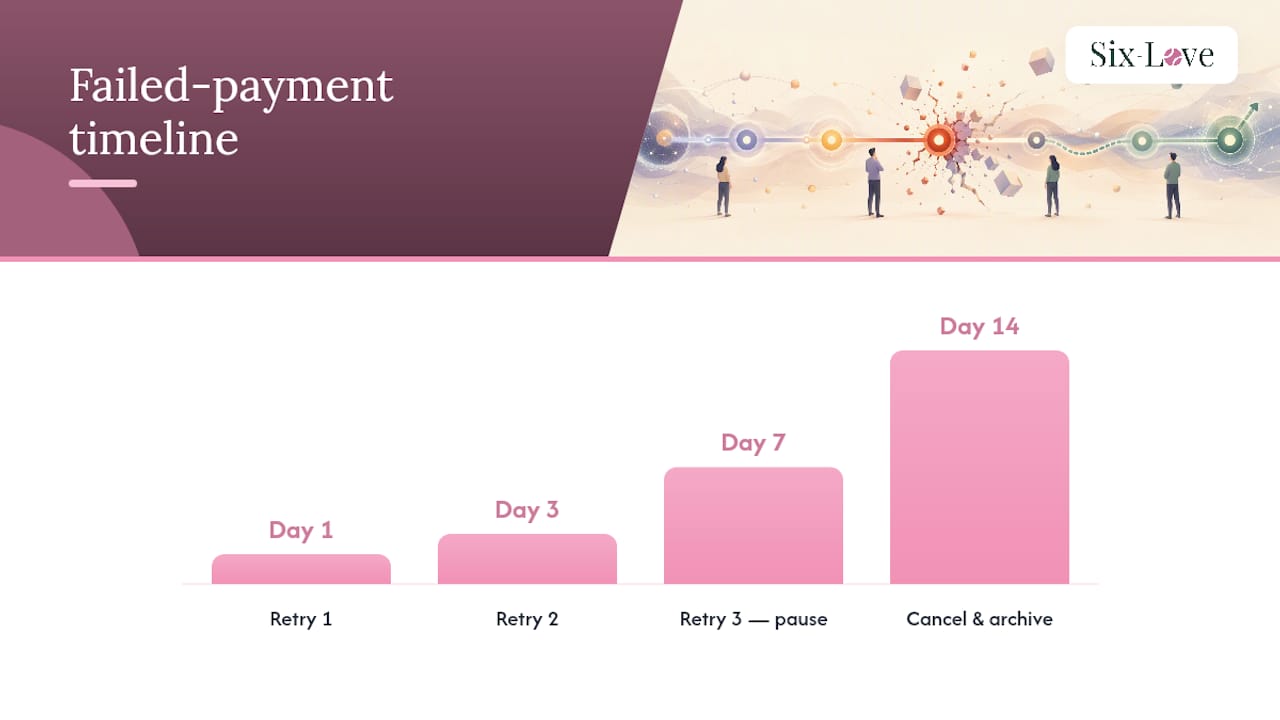
Dunning strategy for failed payments:
- Retry on day 1, day 3, and day 7 after a failed charge, using the PSP’s smart retry windows where available.
- Send an automated email or SMS after each failure, with a direct link to update payment details.
- After three failed attempts, pause membership access rather than cancelling outright, giving the member time to resolve the issue.
- Cancel and archive the subscription only after 14 days of no resolution.
Mollie’s club billing automation tracks failed payments and supports contactless front-desk recovery, which is useful when a member visits in person during a billing dispute.
How do you keep member payment data secure and compliant?
Prefer tokenisation and PSP-hosted or Elements-style flows. That single decision reduces your PCI scope more than any other measure.
PCI DSS in practice: Every major PSP listed here (Stripe, Square, Mollie, GoCardless, PayPal) holds PCI DSS Level 1 certification, the highest tier. When you use their hosted or Elements-based flows, your club system qualifies for SAQ A or SAQ A-EP rather than the full SAQ D, which requires far less compliance work on your side.
UK SCA requires two-factor authentication for most card payments. For recurring subscriptions after the initial authenticated transaction, you can apply the “merchant-initiated transaction” (MIT) exemption, provided you collected proper consent and stored the payment method correctly at sign-up. Your PSP’s documentation will specify the exact flag to set on the API call.
Webhook security matters too. Every incoming webhook should be verified using the PSP’s signing secret before your system acts on it. Stripe, Square, and Mollie all provide signing secrets and verification libraries.
Pro Tip: Never store full card numbers or CVV codes in your own database, ever. Rotate your API keys and webhook signing secrets every 90 days, and restrict API key permissions to only the operations your integration actually needs.
Refunds, chargebacks and bookkeeping
Refund flows vary by PSP but follow a common pattern: issue a full or partial refund via the API or dashboard, referencing the original payment or capture ID. Fees on the original transaction are usually not returned. Timing matters: most PSPs process refunds within 5–10 business days to the member’s card.
For chargebacks, act quickly. When a dispute notification arrives via webhook (charge.dispute.created in Stripe, equivalent events in others), gather evidence: booking confirmation emails, membership agreement, access logs, and any communication with the member. Submit through the PSP’s dispute portal within the deadline, typically 7–21 days depending on the card network.
Reconciliation is where clubs often lose time. Map every PSP transaction to a member record using the metadata fields available on most payment objects. Use webhooks to update invoice status in your club system in real time rather than relying on batch exports. For accounting, most PSPs offer CSV or API exports that map to standard bookkeeping software.
For member-facing refund policies, publishing clear terms reduces disputes. Padel Hip’s returns and refund policy is a practical example of how a sports business structures refund windows and communicates them to customers, which clubs can adapt for membership and event cancellations.
Sandbox testing and go-live checklist
Never skip sandbox testing. A missed webhook or an unhandled decline scenario on day one can mean lost revenue and confused members.
- Create sandbox/test accounts with your chosen PSP and generate test API keys separately from live keys.
- Test card declines using the PSP’s test card numbers: insufficient funds, instrument declined, duplicate invoice ID, and internal server error scenarios. PayPal’s sandbox documents these decline codes explicitly and recommends never creating orders in the browser.
- Trigger and verify each webhook event your system must handle:
payment_intent.succeeded,payment_intent.payment_failed,invoice.paid,invoice.payment_failed, andcharge.dispute.created. - Confirm that each webhook updates the correct member record and access status in your club system.
- Test a full subscription lifecycle: sign-up, successful renewal, failed renewal with retry, and cancellation.
| Test scenario | Expected result | Remediation if it fails |
|---|---|---|
| Successful card payment | Member record updated, access granted | Check webhook handler and event mapping |
| Insufficient funds decline | Dunning flow triggered, member notified | Verify retry schedule and email trigger |
| Duplicate invoice ID | Payment rejected, no double charge | Add idempotency key to API call |
| Chargeback webhook received | Dispute flagged in admin dashboard | Confirm webhook signing secret is verified |
| Subscription renewal | Charge processed, renewal date updated | Check off-session MIT flag and token validity |
Go-live checklist: swap sandbox API keys for live keys, verify webhook endpoints point to production URLs, confirm your HTTPS certificate is valid, run a real £1 test transaction and refund it, and confirm reconciliation exports land correctly in your accounting software.
How Six-love handles payments for racquet clubs
Six-love’s bespoke court reservation and club management platform connects to payment providers through white-label integrations, meaning the payment experience carries your club’s branding rather than a generic PSP page. Built-in reconciliation maps transactions directly to member profiles, so your finance team is not manually matching bank statements to booking records.
Clubs using Six-love have reported a 22% revenue increase within two months of implementation, driven by reduced booking conflicts, automated billing, and the operational visibility that comes from having court reservations, membership data, and payment history in one place.
Six-love’s payment-related trust assets include:
- Sandbox and testing support during onboarding
- Webhook integration for real-time member access updates
- Member portal with payment history and self-service card updates
- Flexible pricing plans to match club size and billing model
- Support for tennis, padel, and pickleball club workflows
Embedded payments and native subscription tooling help software platforms create new revenue streams and reduce manual reconciliation effort, which is exactly the outcome Six-love is built to deliver for racquet clubs.
The part most clubs underestimate
The integration itself is rarely the hard part. Most clubs get payments live within a few weeks. What catches them out is the six months afterwards: a card updater stops running silently, a webhook endpoint goes down after a server migration, or a new SCA rule shifts the authentication requirement for a payment type they use regularly.
Budget for ongoing monitoring, not just setup. Assign someone to review failed payment rates monthly, check webhook delivery logs, and test the dunning flow quarterly. A payment integration is not a one-time project; it is infrastructure that needs the same attention as your booking system or member database.
The clubs that see the best results from payment automation are the ones that treat it as a live operational system, not a completed task.
Six-love gives racquet clubs a faster route to automated billing
Assembling a payment integration from scratch means choosing a PSP, writing webhook handlers, building a dunning flow, and keeping it all compliant as regulations shift. Six-love’s bespoke club management platform handles that complexity for tennis, padel, and pickleball clubs, with white-label payment connections, built-in reconciliation, and a member portal that lets players manage their own billing details.

Clubs that have moved to Six-love report a 22% revenue increase within two months, with the gains coming from automated renewals, fewer booking conflicts, and clearer financial reporting. View the full feature set and pricing to see which plan fits your club, or book a demo to walk through the payment integration options for your specific venue.
Sources
- PayPal developer — Checkout integrate
- Stripe — Quickstart: Checkout Sessions
- Square developer — Online payment options
- Mollie — Club Planner integration
- Club Management ISVs: Go Beyond the Basics in 2025
This article is general information, not a substitute for advice from a qualified financial advisor. Consult a qualified financial professional about your own circumstances before acting on anything here.
FAQ
What is the easiest way to add payments to club management software?
A hosted checkout integration is the lowest-effort starting point: the PSP serves the payment page, your PCI scope is minimal, and implementation typically takes a few hours of developer time.
Does integrating payments into club software require PCI DSS certification?
Not full certification. Using a PCI DSS Level 1 provider with hosted or Elements-style flows reduces your scope to SAQ A or SAQ A-EP, which requires a self-assessment questionnaire rather than a formal audit.
How does Strong Customer Authentication affect recurring membership payments?
The first payment in a subscription requires SCA. Subsequent charges qualify as merchant-initiated transactions (MITs) if you collected proper consent at sign-up, which exempts them from the two-factor requirement.
Which provider is best for UK Direct Debit membership billing?
GoCardless is the specialist for UK Direct Debit mandates, with built-in retry logic and lower transaction costs than card processing at volume.
Can Six-love handle payment integration for a padel or tennis club?
Yes. Six-love’s padel and tennis club management platform includes white-label payment connections, built-in reconciliation, and a member portal with self-service billing, configured for racquet sports workflows.
Recommended
- Migrating from manual booking systems: a club manager’s guide
- General · Six-Love Blog
- Pricing & Plans | Six Love
- The Hub · Six-Love | Insights for Racquet Clubs
Frequently Asked Questions
What is the easiest way to add payments to club management software?
A hosted checkout integration is the lowest-effort starting point: the PSP serves the payment page, your PCI scope is minimal, and implementation typically takes a few hours of developer time.
Does integrating payments into club software require PCI DSS certification?
Not full certification. Using a PCI DSS Level 1 provider with hosted or Elements-style flows reduces your scope to SAQ A or SAQ A-EP, which requires a self-assessment questionnaire rather than a formal audit.
How does Strong Customer Authentication affect recurring membership payments?
The first payment in a subscription requires SCA. Subsequent charges qualify as merchant-initiated transactions (MITs) if you collected proper consent at sign-up, which exempts them from the two-factor requirement.
Which provider is best for UK Direct Debit membership billing?
GoCardless is the specialist for UK Direct Debit mandates, with built-in retry logic and lower transaction costs than card processing at volume.
Can Six-love handle payment integration for a padel or tennis club?
Yes. Six-love's padel and tennis club management platform includes white-label payment connections, built-in reconciliation, and a member portal with self-service billing, configured for racquet sports workflows.