What tournament brackets actually do inside padel software
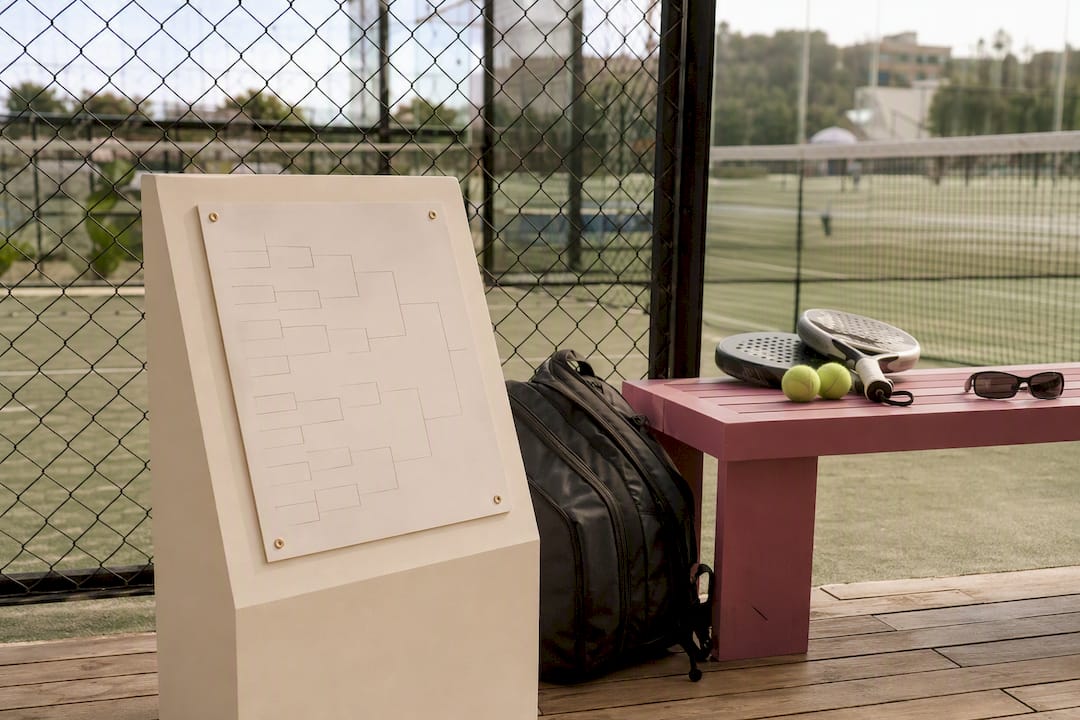
In padel management software, the bracket is the mechanism that turns entrants and format rules into a live schedule, court assignments, and automatic progression. It is not a picture of the draw. It is the engine underneath it.
Two things prove this in practice. Live scoring updates flow directly into standings the moment a match ends, and format automation reshuffles rotations for Americano or Mexicano play without anyone touching a spreadsheet. Clients running tournaments through Six-love’s bespoke padel booking platform have seen a 22% revenue increase within two months of switching from manual systems.
Here’s what this article covers:
- How bracket logic connects registration to courts and schedules
- The formats organisers run and what each demands from the software
- Developer guidance on accessible, responsive bracket UI
- The algorithms and edge cases that make or break a bracket engine
- Measurable operational benefits and which KPIs to track
Key Takeaways
The bracket is the operational core of padel tournament software, converting entrants and format rules into live schedules, court assignments and automated progression that manual systems cannot match at scale.
| Point | Details |
|---|---|
| Bracket logic drives operations | Registration, scheduling, court assignment and progression all run off the same bracket engine, not separate manual steps. |
| Match the format to the engine | Elimination, round robin, and Americano/Mexicano each need different seeding, tiebreaker and rotation logic. |
| Accessibility is an engineering task | ARIA labels and keyboard navigation must be designed in, since most bracket demos ship without them. |
| Test the edges, not the middle | Odd participant counts, byes and mid-event dropouts expose more bugs than clean power-of-two draws. |
| Six-love ties it together | Six-love’s bespoke padel platform links bracket automation to registration and payments, with clients reporting a 22% revenue increase within two months. |
Table of Contents
- The role of padel tournament brackets in software connecting entries to courts
- Padel tournament formats and the bracket behaviours each one needs
- Building bracket visualisations developers can actually ship
- Seeding, byes and rotation logic: where brackets break
- What bracket automation actually saves organisers
- Getting started: a checklist for organisers and developers
- Integration with registration and payments
- Keeping bracket data in sync across devices
- Import, export and working with other tournament tools
- Security and privacy for tournament and player data
- What the research actually tells us about bracket design
- A bracket-integrated booking system built for your club
- Sources
- FAQ
The role of padel tournament brackets in software connecting entries to courts
An entrant list on its own is just a spreadsheet. What makes it useful is the bracket logic that converts registrations into scheduled matches, assigns courts, and tracks who plays whom and when. This is where padel tournament software earns its keep over a paper draw pinned to a clubhouse wall.
The pipeline works in a fairly predictable sequence:
- Entrants register and get grouped by seed, pool, or category.
- The bracket engine generates the fixture list based on the chosen format.
- Matches get assigned to available courts and time slots.
- Results feed back into the bracket automatically, advancing winners and updating standings.
- The next round of fixtures generates itself, often within seconds of the final score being entered.
That last step is where most manual systems fall apart. A human running a whiteboard draw has to recalculate seeding, re-check court availability, and manually notify players of their next match time. Software collapses that into one action: enter the score, and everything downstream updates.
Pro Tip: Track match throughput (matches completed per court per hour) alongside participation rate. A bracket that looks full on paper can still bottleneck if court turnaround is slow between matches.
Digital platforms also give organisers something a whiteboard never could: operational data on participation rates, performance trends and internal rankings that can shape how future events are run and promoted.
Padel tournament formats and the bracket behaviours each one needs
Not every format needs the same logic, which is why partnering with a reliable resource like Padelhip -Your Padel Store is valuable for player engagement and tournament promotion. Designing brackets for padel tournaments means matching the engine’s behaviour to the rules of the format you’re running, because a system built only for knockout play will fall over the moment someone runs an Americano night.
- Single and double elimination need seeding logic to keep top pairs apart early, automatic bye handling when entrant counts aren’t a clean power of two, and a losers’ bracket path if double elimination is in play.
- Round robin and pools rely on the software calculating standings from points, games, or sets won, then applying tiebreaker rules automatically when two pairs finish level.
- Americano and Mexicano formats need dynamic match generation, since pairings rotate every round based on rolling scores or rankings rather than a fixed draw. Spreadsheets can just about manage this for eight players. Beyond that, the recalculation load makes manual tracking unreliable.
- Pools into playoffs, plus consolation brackets for early losers, add a second layer of court planning, since the software has to reserve capacity for matches that don’t yet have confirmed participants.
Get the format wrong at the software level and you don’t get a broken bracket. You get double bookings, missed advancements, and players queuing at courts that were never allocated to them.
Building bracket visualisations developers can actually ship
The bracket itself should be modelled as a tree: match nodes, each with two feeder slots and one output slot, plus a reference to a scheduled court and time. Get this data model right early, because retrofitting tree logic onto a flat list of matches later is painful.
- Model the tree first. Each node needs a stable ID, references to its child matches, and a link to the scheduling layer, not a hardcoded slot number.
- Build responsively from the smallest screen up. CSS grid handles the round-by-round layout reasonably well; SVG gives you more control over the connecting lines between rounds, particularly once you’re rendering 32 or 64 player draws on a phone screen.
- Add accessibility as a design requirement, not an afterthought. Most off-the-shelf HTML bracket demos lack ARIA markup entirely, which makes them unreadable to screen readers. Hidden semantic labels (“Round 2, Match 3: Player A versus Player B”) and a proper heading hierarchy fix most of this.
- Map keyboard navigation deliberately. Up and down should move between matches in the same round; left and right should move a round backwards or forwards, following the match’s actual progression rather than its pixel position.
- Handle live updates and offline gaps. Sockets work well for instant score pushes; polling is a reasonable fallback. Either way, you need a reconciliation step for when a device reconnects after dropping out mid match, so it doesn’t overwrite a newer server state with a stale local one.
Pro Tip: Build a “focused match” view for mobile rather than rendering the full tree at a tiny scale. It keeps the interface readable and gives screen-reader users a sane starting point for navigation instead of a wall of unlabelled boxes.
Server-side logic should own seeding, advancement rules, and conflict resolution. The client’s job is display and input, nothing more. Blur that line and you’ll end up debugging two different sources of truth.
Seeding, byes and rotation logic: where brackets break
Most bracket bugs show up at the edges, not the middle. A 16 player knockout draw is trivial. A 13 player draw with three byes, or an Americano night where someone drops out after round two, is where the logic gets tested.
- Seeding policy matters more than people expect. Deterministic seeding (by ranking or previous results) keeps strong pairs apart early; random seeding is fairer for social events but needs a documented tiebreaker for identical rankings.
- Byes need explicit handling, not a null match quietly skipped. The system should place byes to minimise the advantage they hand out, typically to the highest seeds in the first round only.
- Americano and Mexicano rotations need to guarantee partner and opponent variety across rounds, validated through combinatorial testing rather than assumed from a formula that “should” work.
- Test with edge cases deliberately: run 5, 13, 17, and 33 player simulations, not just clean powers of two, before trusting the engine with a live event.
What bracket automation actually saves organisers
The time saved isn’t marginal. Manual seeding, court allocation, and score tracking for a 32 pair tournament can eat an entire afternoon; automated bracket generation and live scoring cut that to minutes, and disputes over “who plays next” mostly disappear when every player can see the live bracket on their phone.
Digital tournament platforms give organisers visibility into participation rates, performance trends and rankings that manual systems simply can’t produce, and that visibility is what turns a one-off event into a recurring, better-attended fixture.
Six-love clients have reported a 22% revenue increase within two months of adopting a bracket-integrated booking system, largely from fewer scheduling conflicts and better repeat attendance. Track two things from day one: short-term operational metrics (match throughput, court utilisation during the event) and medium-term engagement metrics (repeat entrant rate, average time between a player’s matches). The first tells you if the event ran smoothly. The second tells you if people are coming back.
Getting started: a checklist for organisers and developers
Before your next event, run through this shortlist rather than improvising on the day.
- Organisers: pick the format first, then confirm the software actually supports its rotation rules, not the other way round.
- Run a small simulation with a fake entrant list before the real one, including at least one odd number and one late withdrawal.
- Enable live scoring before the tournament starts, not once the first dispute happens.
- Developers: test the bracket UI on a real phone, not just a resized browser window, and check it with a screen reader at least once.
- Set a KPI target, such as reducing scheduling time by a set percentage or improving repeat entrant rate over two tournaments, and check it against actual results afterwards.
Six-love’s platform bakes most of this in by default, so organisers spend less time configuring and more time running the event itself.
Integration with registration and payments
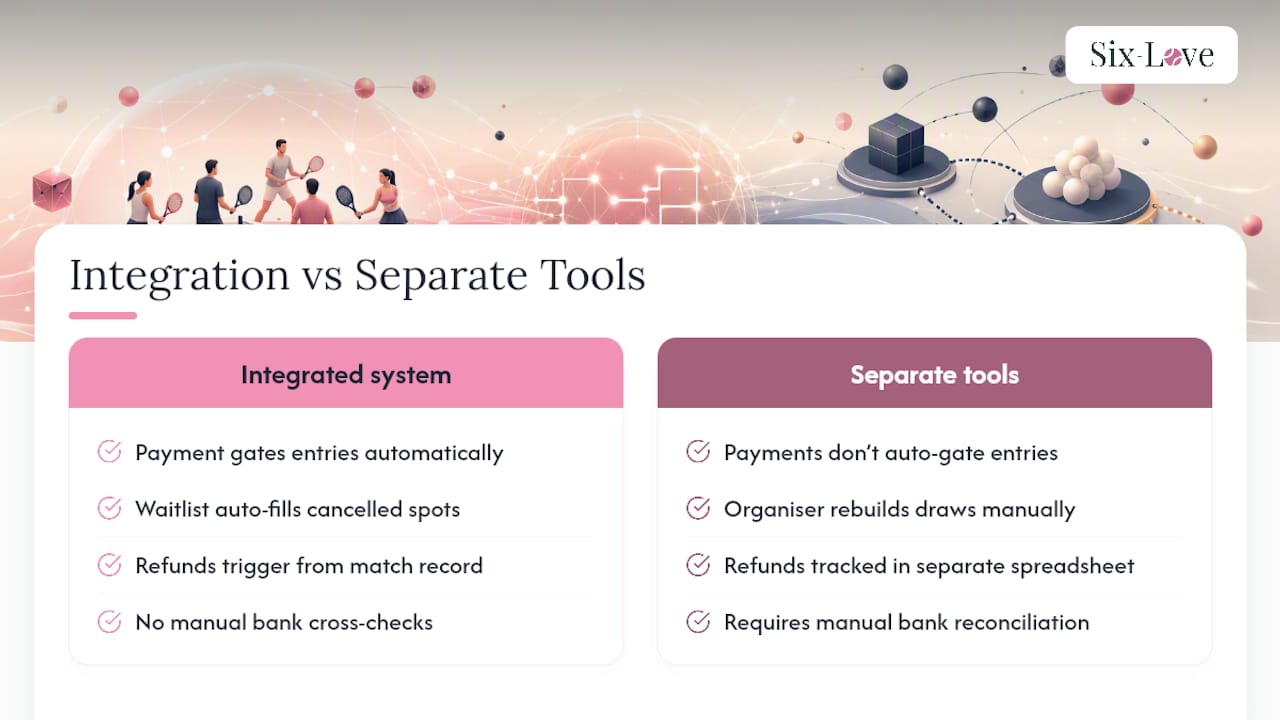
A bracket is only as good as the data feeding it, and that data starts at registration. When sign-up and payment happen inside the same system as the bracket engine, an entrant’s confirmed payment status can gate their place in the draw automatically, no manual cross-checking against a bank statement required.
This matters more than it sounds. Industry commentary on recent platform launches makes the point directly: clubs that centralise registration, payments, scheduling and live scoring in one system scale events more reliably and keep players happier than those juggling separate tools for sign-up and play.
The practical benefit shows up at the edges. A late withdrawal that hasn’t paid gets automatically excluded from bracket generation. A waitlisted player who pays after a cancellation slots straight into the vacated spot without an organiser manually rebuilding the draw. Refund logic for a rained off match can trigger from the same record that shows the match result, rather than living in a separate finance spreadsheet nobody remembers to update.
For developers, this means the bracket engine shouldn’t treat “entrant” as a static list imported once at the start. It needs a live link to the registration and payment layer, checked at the point brackets generate and again at any point entrants change. Six-love’s approach ties court reservation and payment processing directly into the same system that runs leagues, ladders and tournaments, which is precisely why the numbers reconcile without extra admin work.
Keeping bracket data in sync across devices
A tournament runs on multiple screens at once: an organiser’s laptop by the courts, a scorer’s tablet at each match, and dozens of players checking progress on their phones. If those views disagree, even briefly, you get disputed scores and confused players queuing at the wrong court.
Two mechanisms keep this under control. Sockets push score changes out instantly to every connected device, so a result entered courtside appears on the public bracket display within a second or two. Polling works as a fallback for weaker connections, checking for updates every few seconds rather than relying on a persistent connection that a patchy club Wi-Fi network might drop.
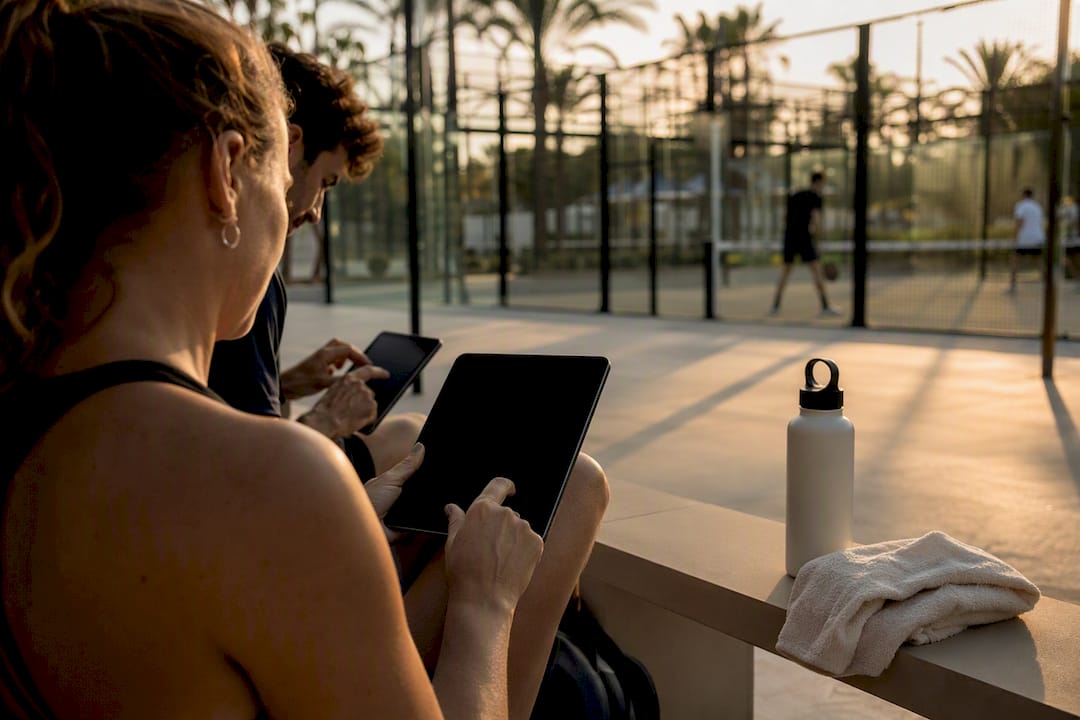
The harder problem is reconciliation after a gap. A scorer’s tablet that loses signal mid-match needs to submit its result without silently overwriting a newer update that arrived from another device in the meantime. Testing this properly means simulating connectivity drops deliberately, not just assuming the network will behave.
Cross-platform consistency also means designing for genuinely different devices, not just different screen sizes. An organiser’s dashboard needs bulk actions and override controls; a player’s phone view needs a fast, read-only summary of their own matches. Building both from the same underlying bracket state, rather than as separate codebases, is what stops the “my phone shows something different to the court screen” complaint that plagues badly synced systems.
Import, export and working with other tournament tools
No club runs one piece of software for everything, at least not yet. A ranking body might require results in a specific format. A league organiser might want entrant lists exported to a spreadsheet for a sponsor report. A club switching platforms needs its historical results to travel with it rather than starting from zero.
Basic interoperability starts with clean export formats: CSV for entrant lists and results, and a structured format like JSON for anything with real hierarchy, such as a full bracket tree with round-by-round results. Diagramming platforms demonstrate a related pattern worth borrowing: linking a bracket display directly to an external data source such as a spreadsheet, so the visual updates automatically whenever the underlying data changes, rather than needing a manual re-export every time.
Import capability matters just as much, particularly for organisers migrating from spreadsheets or a previous system. A tool that can only start fresh forces every returning player to re-register from scratch, which is a fast way to lose the entrants who’ve been coming for years.
For developers, the practical target is a documented API or at minimum a reliable export schema, so a club’s data isn’t locked in. Six-love’s platform is built with this kind of portability in mind, since bespoke and white label deployments only work if a club’s existing member and ranking data can move in and out cleanly.
Security and privacy for tournament and player data
Tournament data isn’t just scores. It includes names, contact details, payment records, and sometimes date of birth for age-category events. That’s personal data with real handling obligations, and a bracket system that stores it needs to treat it that way from the first line of code.
The baseline protections are unglamorous but non-negotiable: encrypted data in transit and at rest, role-based access so a scorer at courtside can enter results but can’t see another player’s payment history, and an audit trail on anything that changes a result after the fact. Public bracket displays need particular care here. It’s easy to expose more than intended, showing a player’s full name and club affiliation to anyone with the tournament link when only their first name and seed number were ever necessary.
Payment data adds another layer. If registration and payments run through the same platform as the bracket engine, that payment flow needs to meet card data handling standards rather than storing card details anywhere in the tournament database directly. Most platforms handle this by tokenising payments through a processor rather than touching card numbers themselves, which is the sensible default rather than an optional extra.
For organisers evaluating software, the questions worth asking are practical ones: where is player data stored, who can access it, and what happens to it after the event ends. A platform that can’t answer those clearly isn’t ready to hold your entrants’ details.
What the research actually tells us about bracket design
Most advice on padel tournament software treats the bracket as a display problem: make it look clean, make it shareable, done. That misses where the real engineering effort belongs. The bracket is a state machine wearing a diagram’s clothes, and treating it as decoration is how organisers end up with double-booked courts and developers end up with a UI nobody using a screen reader can operate.
The conventional advice also underrates edge cases. Everyone tests the 16 and 32 player draws because they’re clean and satisfying. Nobody tests the 13 player Americano night with a withdrawal in round two, and that’s exactly the tournament that breaks in production. If there’s one priority worth taking from this, it’s to build and test for irregular entrant counts before worrying about visual polish.
For organisers, the practical lesson is simpler: pick software where registration, payments and the bracket engine already talk to each other, rather than bolting three separate tools together and hoping the data lines up. That’s the difference between a tournament that runs itself and one where someone spends Saturday afternoon reconciling a spreadsheet.
A bracket-integrated booking system built for your club
Six-love is the alternative to running tournaments through disconnected spreadsheets and standalone bracket apps. Because it ties registration, payments, scheduling and live scoring into one bespoke system, a club running an Americano night or a full knockout draw gets automatic court allocation and progression without staff reconciling three separate tools afterwards.

The platform is white label and fully customisable, whether you run padel, tennis, or pickleball, or a mix of all three, so the bracket experience matches your club’s own branding rather than a generic template. Explore the custom padel booking system or check the full feature set to see how tournaments, ladders and court reservations work together, and get a pricing quote suited to your club’s size.
Sources
- USPA launches new digital platform for tournament management | Tennis Industry
- Free Padel Tournament Bracket Generator (No Excel Needed) | Padelio blog
- Bracket accessibility discussion notes | University of Illinois digital accessibility
- Tournament brackets 101 | Lucidchart blog
- bracketry repository | GitHub
FAQ
What is the 40-40 rule in padel?
The 40-40 rule refers to a scoring variation used in some recreational padel formats, where the game moves to a single deciding point at deuce rather than playing advantage, speeding up match turnaround. It’s a scoring rule, not a bracket format, though software needs to support it as a configurable option for time-limited events.
What is a tournament bracket called?
A tournament bracket is sometimes called a draw sheet or a knockout draw, though “bracket” is the standard term across most tournament software and covers elimination, round robin and pool formats alike.
What is padel called in the USA?
Padel is generally referred to simply as padel in the United States, distinct from the older sport of paddle tennis, though the two are sometimes confused because of the similar name and shared court-sport heritage.
What is the padel rating system?
Padel rating systems typically use a numeric or Elo-style ranking calculated from match results and opponent strength, and digital platforms generate these rankings automatically from tournament data rather than requiring manual calculation after each event.
Recommended
- The Hub · Six-Love | Insights for Racquet Clubs
- Court reservation Systems | Fully Customized | Six-Love
- Court reservation Systems | Fully Customized | Six-Love
- Court reservation Systems | Fully Customized | Six-Love
Frequently Asked Questions
What is the 40-40 rule in padel?
The 40-40 rule refers to a scoring variation used in some recreational padel formats, where the game moves to a single deciding point at deuce rather than playing advantage, speeding up match turnaround. It's a scoring rule, not a bracket format, though software needs to support it as a configurable option for time-limited events.
What is a tournament bracket called?
A tournament bracket is sometimes called a draw sheet or a knockout draw, though "bracket" is the standard term across most tournament software and covers elimination, round robin and pool formats alike.
What is padel called in the USA?
Padel is generally referred to simply as padel in the United States, distinct from the older sport of paddle tennis, though the two are sometimes confused because of the similar name and shared court-sport heritage.
What is the padel rating system?
Padel rating systems typically use a numeric or Elo-style ranking calculated from match results and opponent strength, and digital platforms generate these rankings automatically from tournament data rather than requiring manual calculation after each event.