How SaaS deployment works for sports clubs: a manager’s guide

SaaS deployment for a sports club is a cloud subscription rollout: one vendor hosts your booking system, member database, payments, and reporting in a single platform, then handles the updates and security patches going forward. Instead of buying servers and hiring IT staff to run software on-site, you rent access to a system that someone else builds, maintains and secures.
Three things follow immediately from that setup. First, upfront cost drops sharply because there’s no hardware to buy and no licence to purchase outright. Second, time-to-live shrinks. SaaS deployments in sports can go from months to days or weeks, compared with traditional on-premises builds. Third, you never manage a server patch or a security update again. The vendor does it, usually overnight, without asking you.
- Lower upfront cost: no servers, no perpetual licence fees, just a monthly subscription
- Faster go-live: cloud rollouts measured in weeks, not the six-to-twelve months typical of on-premises IT projects
- Vendor-managed security: patching, backups and uptime become someone else’s job
A typical club rollout runs four to eight weeks from signed contract to full go-live, and most vendors recommend a phased approach: a pilot with one court or one team before opening the system to your whole membership.
Key Takeaways
SaaS deployment for a sports club succeeds when phased rollout, clean data migration and vendor-managed security are treated as equally important as the software’s feature list.
| Point | Details |
|---|---|
| Deployment moves fast | Most club rollouts run four to eight weeks from signed contract to full go-live. |
| Sequence adoption carefully | Launch booking and payments first, then add coaching, leagues and analytics once staff trust the system. |
| Budget beyond the subscription | Factor in one-off setup or import fees alongside monthly subscription costs. |
| Insist on data ownership terms | Confirm portability, backup retention and breach notification timelines before signing. |
| Six-love delivers bespoke racquet-sport rollouts | Its phased deployment model helped one club achieve a 22% revenue increase within two months. |
Table of Contents
- How SaaS deployment works for sports clubs, step by step
- Timeline and costs: what to budget for
- Data migration and integrations you need to plan for
- Security, access and data ownership: what to insist on in your contract
- Training staff, coaches and members without the pushback
- Measuring success: the KPIs that actually matter
- A real deployment: what changed for one racquet club
- What most deployment advice gets wrong
- Why racquet clubs choose a bespoke platform over generic booking tools
- Sources
- FAQ
How SaaS deployment works for sports clubs, step by step
Every credible deployment follows roughly the same sequence, whether you’re running two padel courts or a twelve-court tennis and pickleball complex. Vendors and their onboarding teams will walk you through this, but knowing the order in advance means you turn up to each call with the right information ready.
- Pre-purchase discovery. Define what you actually need: court booking, payment processing, membership management, coaching schedules, leagues and ladders with a sports game organiser app. Identify every existing data source, from a spreadsheet of members to a legacy booking system, and flag anything that needs to integrate, such as your accounting software or a POS terminal at the clubhouse bar.
- Contract and account setup. Choose a subscription tier, then set up your account structure. Larger operators with multiple sites often work with a global account and separate subaccounts per venue, similar to the subaccount and identity provider model documented by enterprise sports platforms. Assign admin roles at this stage so front-desk staff, coaches and owners each see only what they need.
- Configuration and data import. This is where your member list, court schedules and pricing rules get loaded, usually via CSV upload, plus API connections to your payment gateway and calendar tools.
- Pilot and phased rollout. Test with one court, one coach group or one league before opening to everyone. Gather feedback, fix friction points, then expand.
- Go-live and post-launch checks. Reconcile the first week of payments, confirm every staff member can log in with the right permissions, and watch booking patterns closely for the first few days.
Pro Tip: Run your pilot during a quiet week, not your busiest tournament fortnight. A booking glitch during a slow Tuesday is an inconvenience; the same glitch during finals weekend is a crisis.
Timeline and costs: what to budget for
Discovery and contract signing typically take one to two weeks. Configuration and data import run another one to three weeks, depending on how messy your existing member records are. A pilot phase lasts a further one to two weeks, and full roll-out to every court and member usually follows within a month of signing.
Costs break down into a few predictable categories:
- Subscription fees, billed monthly, scaled to club size and modules used
- One-off setup or data import fees, particularly where historical booking or member data needs cleaning before it can be migrated
- Optional customisation costs for bespoke features, branded member portals or unusual integrations
- Optional booking commissions, which some vendors charge instead of, or alongside, a subscription for non-membership or pay-per-play clubs
Complex integrations stretch the timeline. A club connecting three different payment processors, importing a decade of handwritten booking logs, or requesting a fully bespoke coaching module should expect the process to run closer to eight weeks than four. Straightforward single-site clubs with clean member data move faster.
Data migration and integrations you need to plan for
Most clubs underestimate how much of the deployment timeline goes into moving and connecting data, not configuring the software itself. The common integration points are payment gateways, calendar tools like Google or Outlook, point-of-sale systems at the pro shop or café, accounting exports, and third-party coaching or matchmaking services.
Migration itself follows a simple pattern: extract your existing data, clean it, map it to the new platform’s fields, import it, then reconcile the totals against your old system before you switch off. Member databases exported from spreadsheets are usually straightforward. Payment histories and outstanding balances cause more headaches, because field names rarely match between old and new systems.
- Payment gateways and POS terminals for on-site transactions
- Calendar sync for coaches and multi-court scheduling
- Accounting software exports for bookkeeping
- Third-party ladder, league or matchmaking tools
APIs handle real-time updates, such as a booking instantly blocking a slot across every connected calendar. Scheduled syncs, refreshing every few hours, are fine for less time-sensitive data like historical revenue reports.
Pro Tip: Test every integration with dummy transactions before go-live, particularly payment gateways. A failed real payment during your first live week damages member trust far more than a delayed launch does.
Security, access and data ownership: what to insist on in your contract
Cloud platforms use multi-tenant architectures, meaning many clubs share the same underlying software while their data stays logically separated so one club can never see another’s records. Ask your vendor directly how that isolation works, along with role-based access controls, encryption both at rest and in transit, and how often the platform is patched.
Contractually, four things matter most:
- Data ownership, confirming your member and booking data belongs to you, not the vendor
- Data portability, so you can export everything if you ever switch providers
- Backup retention and breach notification timelines, spelled out in days, not vague language
- Service-level commitments covering uptime and support response times
- Ask who can access your member data, and under what circumstances
- Confirm backup frequency and how long backups are retained
- Get breach notification timelines in writing, not just verbal assurance
Training staff, coaches and members without the pushback
The hardest part of any deployment isn’t the technology. It’s getting people to actually use it. Adoption tends to succeed when rollouts prioritise the most visible, most-used features first, building trust with staff and members before introducing anything more complex.
Start with court booking and payments, the two features everyone touches weekly. Once those feel routine, layer in coaching schedules, leagues and analytics dashboards.
- Short video micro-lessons for members on how to book and pay
- A dedicated admin workshop for front-desk staff covering the full back end
- Power-user sessions for coaches who’ll field questions from players
- A simple FAQ page linked from your launch email
A launch email announcing the new system, a reminder a few days before go-live, and quick in-app tips during the first fortnight cover most of the communication load. Resist the urge to explain every feature at once.
Measuring success: the KPIs that actually matter
Once the system is live, the numbers worth watching are active users, booking rate per court, revenue per available court hour, no-show rate, how long payment reconciliation takes each week, and the admin hours your team saves compared with the old process.

Check these weekly for the first month, when problems surface fastest. Move to monthly reviews once things stabilise, then run a proper quarterly strategic review. If booking history data shows consistent peak-time waitlists, that’s your signal to consider adding a module, such as automated waitlist management, rather than guessing at what members want.
A real deployment: what changed for one racquet club
A multi-court racquet club running tennis, padel and pickleball moved from a mix of spreadsheets and a generic booking widget to Six-love, covering court reservations, payments, a branded member portal and revenue analytics. The rollout followed the phased model above: discovery and configuration in the first two weeks, a pilot across two courts, then full expansion to every court and sport within a month.
Key configuration choices included custom pricing rules for peak versus off-peak play across three sports, and a payment gateway integration handling both membership dues and pay-per-play bookings.
The result: a notable revenue increase within a short period after implementation, driven largely by reduced booking conflicts and better visibility into which courts sat empty during off-peak hours. That kind of uplift comes from operational clarity as much as the software itself: managers could finally see, in real time, where demand actually was. Clubs considering a similar move can explore a Six-love demo to see the same modules in action.
What most deployment advice gets wrong
Most guidance on SaaS deployment treats it as a purely technical exercise: pick a vendor, migrate the data, flip the switch. That framing misses the part that actually determines whether a rollout succeeds, which is sequencing around your members’ habits, not your admin team’s convenience.
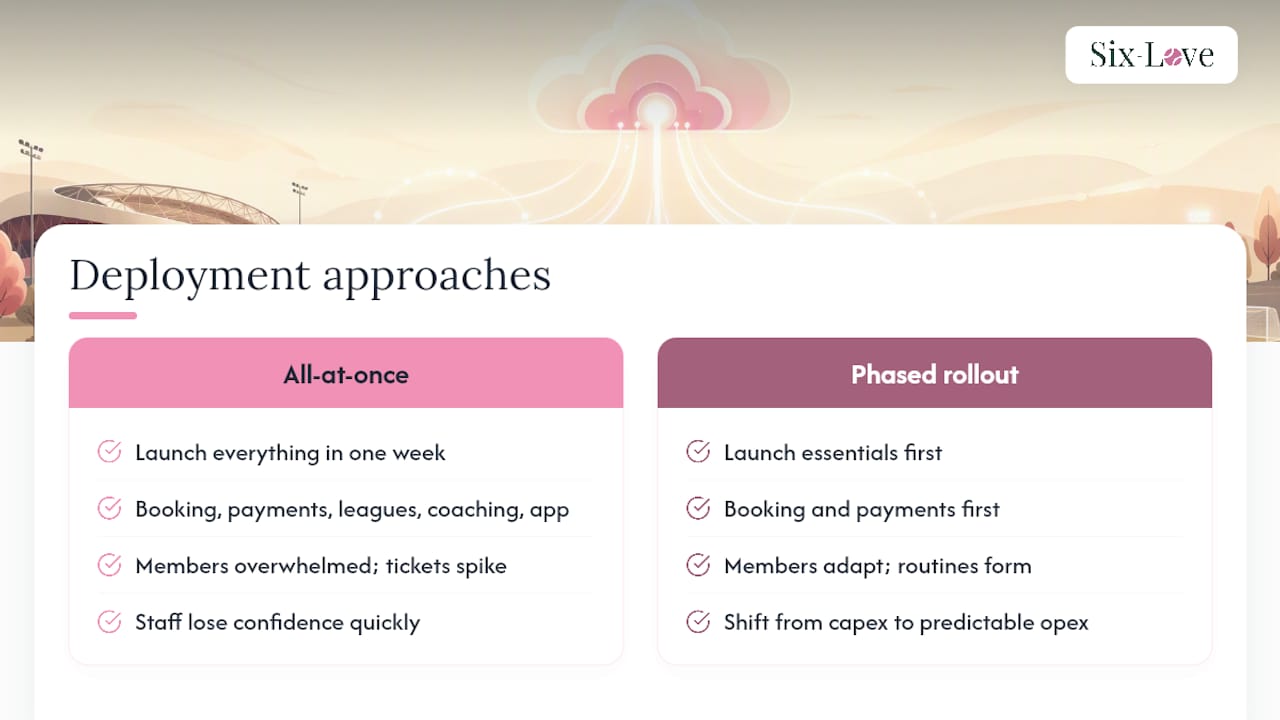
Clubs that fail at this usually try to launch everything simultaneously: booking, payments, leagues, coaching schedules and a new member app, all in one week. Members get overwhelmed, support tickets pile up, and staff lose confidence in the platform before it’s had a chance to prove itself. The clubs that succeed do the opposite. They launch booking and payments first, because those are the two things every member touches every week, and they wait until that feels boring and routine before introducing anything else.
The other overlooked point: vendor-managed updates aren’t a minor convenience, they’re the entire economic case for SaaS. The shift from unpredictable capital spending to predictable operating costs matters more over three years than any feature comparison you’ll do during procurement. Ask about update frequency and rollback procedures before you ask about dashboard colours.
Why racquet clubs choose a bespoke platform over generic booking tools
Generic booking widgets and spreadsheet workarounds get clubs through the early years, but they buckle once you’re running multiple courts across tennis, padel and pickleball with different pricing rules, coaching schedules and member tiers. Six-love was built specifically for that complexity, not adapted from a general-purpose scheduling tool.
What sets it apart for racquet clubs specifically:
- A fast, phased rollout built on the same discovery-to-go-live model covered above, typically live within weeks
- Bespoke configuration for tennis, padel and pickleball pricing, coaching, and member rules, rather than a one-size-fits-all template
- Racquet-sport focus, including automated waitlists, ladders, tournaments and QR code check-in designed around how these sports actually run
- Onboarding and support included, so your team isn’t left configuring integrations alone
If you’re weighing up a move from spreadsheets or a generic tool, request a Six-love demo or check the pricing plans to see how a bespoke rollout would look for your courts. Clubs running dedicated pickleball or padel programmes can also look at the pickleball scheduling system or padel booking platform directly.
Sources
- The hidden value of SaaS in sports streaming: beneath the tip of the iceberg | Synamedia
- SaaS vs on‑premises | Deltek
FAQ
Is SaaS being replaced by AI?
No. AI features, such as weather-based scheduling or matchmaking, are increasingly built into SaaS platforms rather than replacing them; SaaS remains the delivery model that hosts and runs those AI features.
Is Netflix an example of PaaS?
No, Netflix is a SaaS product. It delivers a finished application to subscribers rather than a platform on which developers build their own software, which is what PaaS (Platform as a Service) provides.
Is ChatGPT considered SaaS?
Yes, ChatGPT is generally classified as SaaS, since it’s a cloud-hosted application accessed by subscription without any local installation or infrastructure management required by the user.
What are the top SaaS companies for sports clubs?
The field includes platforms like SAP Sports One for large sports organisations, Teamworks for team communication and scheduling, and Six-love for racquet-sport clubs needing bespoke court booking and member management.
How long does SaaS deployment take for a small club?
A single-site club with clean member data can typically go live within four weeks, covering discovery, configuration, a short pilot and full roll-out.
Recommended
- Migrating from manual booking systems: a club manager’s guide
- General · Six-Love Blog
- Features | Six Love – Club Management Tools
Frequently Asked Questions
Is SaaS being replaced by AI?
No. AI features, such as weather-based scheduling or matchmaking, are increasingly built into SaaS platforms rather than replacing them; SaaS remains the delivery model that hosts and runs those AI features.
Is Netflix an example of PaaS?
No, Netflix is a SaaS product. It delivers a finished application to subscribers rather than a platform on which developers build their own software, which is what PaaS (Platform as a Service) provides.
Is ChatGPT considered SaaS?
Yes, ChatGPT is generally classified as SaaS, since it's a cloud-hosted application accessed by subscription without any local installation or infrastructure management required by the user.
What are the top SaaS companies for sports clubs?
The field includes platforms like SAP Sports One for large sports organisations, Teamworks for team communication and scheduling, and Six-love for racquet-sport clubs needing bespoke court booking and member management.
How long does SaaS deployment take for a small club?
A single-site club with clean member data can typically go live within four weeks, covering discovery, configuration, a short pilot and full roll-out.