Why clubs track court booking history: a practical guide
Why clubs track court booking history: a practical guide

Court booking history is the complete record of every reservation made, modified, cancelled, or completed at a club. Clubs track court booking history because it turns raw scheduling data into decisions about staffing, pricing, court allocation, and member communication. Without it, managers operate on guesswork. Sports organisations that integrate booking analytics report over 30% improvement in conversion rates within the first year. That figure reflects a shift from reactive management to one driven by evidence. For tennis, padel, and pickleball clubs alike, the importance of booking history extends well beyond knowing who played when.
Why clubs track court booking history: the operational case
Tracking court booking history gives club managers a factual picture of how courts are being used. Peak hours, quiet periods, and recurring no-shows all become visible once you have a complete record. That visibility is the foundation of every good scheduling decision.
When we introduced booking history into Six-Love, we included some features to help clubs identify key metrics. Our clubs can identify the best performing sports, times, coaches, groups and events in any time period. And, as an added bonus, we included an occupancy percentage where clubs can view their occupancy and assess if it is on the increase or decline.

Matching court supply to real demand
Historical booking data shows exactly when courts are oversubscribed and when they sit empty. A padel club that reviews three months of records might find that courts 3 and 4 are fully booked every Saturday morning but unused on Tuesday afternoons. That pattern justifies opening Tuesday slots to group coaching, running a discounted social session, or scheduling maintenance without disrupting members. Without the history, those decisions rely on memory and assumption.
Reducing double bookings is a direct benefit of monitoring court usage. When a system logs every reservation in real time, it flags conflicts before they reach the court. Booking systems that provide centralised management and automated confirmations eliminate the manual errors that cause double bookings in the first place.
Scheduling maintenance without disrupting play
Court surfaces, nets, and lighting all require regular upkeep. Booking history reveals which courts carry the heaviest load and which time slots are consistently light. Maintenance teams can schedule resurfacing or net replacement during the quietest windows rather than pulling a court mid-peak. That approach reduces member complaints and extends the life of court infrastructure.
Pro Tip: Review your booking history in four-week blocks rather than weekly. Weekly snapshots miss seasonal patterns. A four-week view shows whether a quiet Tuesday is a trend or a one-off.
How does booking history improve member engagement?
Member engagement rises when clubs use booking data to communicate in ways that feel relevant rather than generic. A member who books every Thursday evening does not need a Tuesday morning reminder. Booking history makes that distinction possible.
Sports clubs that monitor booking records can personalise services and eliminate scheduling conflicts that frustrate members. Personalisation at this level builds loyalty. Members who feel the club understands their habits are far more likely to renew, refer friends, and spend on coaching or merchandise.
Automated reminder notifications are one of the most direct tools for reducing no-shows. Online booking systems that send reminders and provide instant availability checks reduce no-shows and improve the overall member experience. A no-show is not just a wasted court. It is a missed revenue opportunity and a frustration for members on a waitlist.
Sharing booking trends with members also builds a sense of community. A monthly update showing which courts are busiest, when new slots open, or how many matches were played across the club gives members a stake in the club’s story. Transparency of this kind is rare in racquet sports clubs and creates genuine differentiation.
Personalised offers: Members who book consistently at specific times receive targeted promotions for coaching, equipment, or guest passes tied to those slots.
Automated reminders: Notifications sent 24 hours and 2 hours before a booking cut no-show rates without any manual effort from staff.
Waitlist management: When a cancellation occurs, booking history identifies the most likely replacement member based on past behaviour and preferred times.
Loyalty recognition: Members with high booking frequency can be flagged automatically for loyalty rewards or priority booking windows.
Pro Tip: Use booking frequency data to identify members who have gone quiet. A member who booked weekly for six months and then stopped is a retention risk. A targeted message at that point costs nothing and can recover a lapsing relationship.
When we introduced a local tennis club to our booking data and analytics, they were able to easily identify the most popular groups and coaching squads, and increase these according to the data. The end result was more court time, and an increase in occupancy by 12% , just by utilising this one feature.
What key metrics come from court booking data?
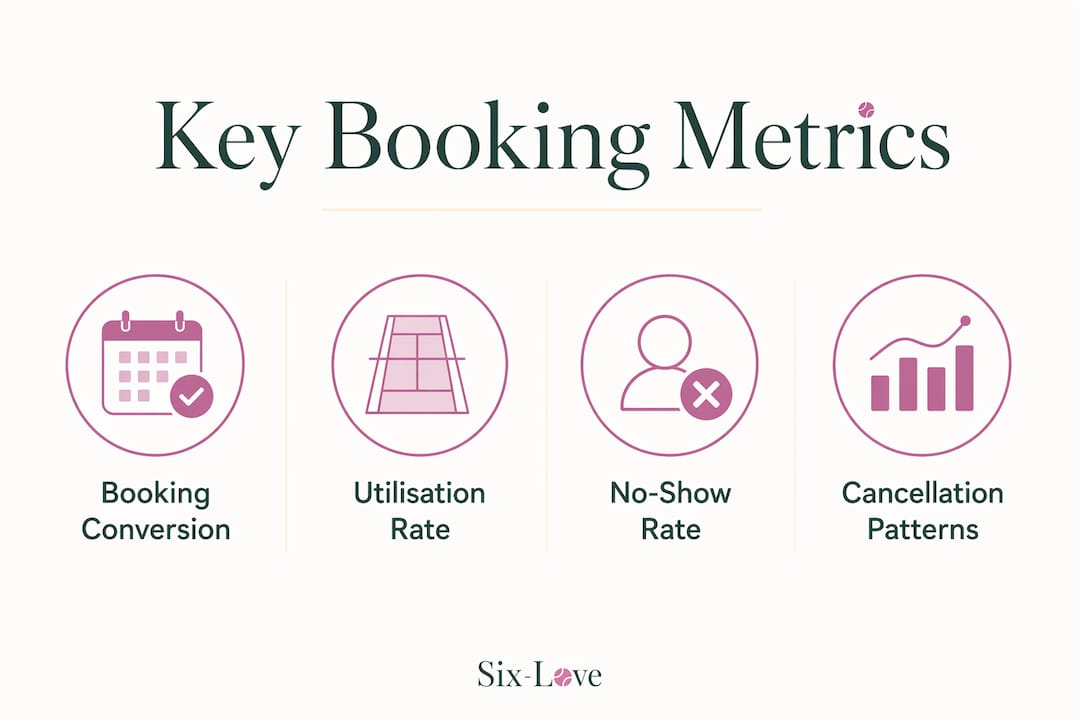
Court booking analytics produce a set of metrics that directly inform how a club prices, staffs, and markets itself. Each metric answers a specific operational question.
Booking conversion rate measures how many members who view available slots actually complete a booking. Organisations that integrate analytics into their workflows see conversion improvements of over 30% in the first year. A low conversion rate on a specific court or time slot signals a pricing, visibility, or usability problem worth investigating.
Court utilisation percentage shows what proportion of available court time is actually booked. A court sitting at 40% utilisation during peak hours is a revenue problem. One sitting at 95% consistently may need a waitlist or dynamic pricing to manage demand. the ability to identify this is key, when managing a racquets sport venue.
No-show rate and cancellation patterns reveal whether your booking policy is working. A high no-show rate on free bookings suggests a deposit or cancellation fee would change behaviour. A spike in cancellations on rainy days points to a need for covered courts or a clear weather policy.
Business intelligence dashboards that surface KPI cards for bookings, yield, and client growth give managers a real-time view of these metrics. The same principle applies to court booking platforms: a well-built dashboard turns raw reservation data into decisions.
When we introduced a now show warning for our clubs, where members who don't show up for their booking received warnings, we found that no shows were reduced by 72% overall. When players realised that no-shows were monitored, they became much more likely to cancel in good time or not miss their slot. And of course this naturally increases available court times and booking revenue.
How do bespoke booking systems support tracking and analytics?
A bespoke or white-label court booking system must always do more than just accept reservations. It should capture, store, and highlight the key data points that make tracking useful. Generic scheduling tools rarely provide the depth of analytics that a racquets club needs. It was one of the key reasons we developed Six-love.
Migrating from manual booking systems to a high-level digital platform reduces errors and unlocks the booking analytics that manual records simply cannot produce. A spreadsheet shows you who booked. A purpose-built system highlights the patterns, trends, and anomalies across many months and even years of data.
Six-love is built specifically for tennis, padel, and pickleball clubs to do exactly that, and more. Our platform combines court reservation management with a member portal, real-time analytics, and payment gateway integration. Clubs using Six-love have reported anaverage 22% revenue increase within two months of implementation. That result is influenced heavily by having better data and acting on it.
Key capabilities that support booking history tracking include:
Real-time dashboards: Managers see current bookings, cancellations, and utilisation rates without pulling reports manually.
Payment integration: Every booking links to a transaction record, so revenue tracking is automatic rather than reconstructed at month end.
Automated notifications: Reminders, confirmations, and waitlist alerts go out without staff involvement, reducing errors and saving time.
Custom reporting: Clubs can filter booking history by court, member, time slot, or sport to answer specific operational questions.
Data security: Member booking records are stored securely, with access controls that meet privacy expectations and data protection obligations.
For clubs running pickleball court scheduling or padel booking systems, the ability to customise the platform to each sport’s specific booking patterns is a huge material advantage over generic tools.
Common challenges when tracking court booking history
Tracking booking history only delivers value if the data is accurate and consistently collected. Several common problems can often undermine the data.
Inaccurate data entry is a frequent issue in clubs that mix manual and digital processes. A staff member who logs a walk-in booking on paper but forgets to enter it digitally creates a gap in the record. That gap distorts utilisation figures and makes the booking history unreliable. Full digital adoption removes this risk.
Incomplete history is a related problem. Clubs that switch systems mid-year often lose historical data from the previous platform. Before migrating, export and archive all existing booking records. A continuous history spanning two or more years is far more useful than six months of clean data.
Privacy compliance is a genuine obligation. Member booking records contain personal data. Clubs must store that data securely, limit access to authorised staff, and comply with data protection regulations. A reputable booking platform handles much of this automatically, but club managers remain responsible for their data governance policies.
Run a monthly data audit: Check for missing bookings, duplicate entries, and anomalies that suggest a process failure.
Train all staff on the booking system: Inconsistent use by different team members is a leading cause of data gaps.
Set a data retention policy: Decide how long booking records are kept and communicate that policy to members.
Focus on three to five key metrics: Tracking every possible data point creates noise. Identify the metrics that directly affect your club’s goals and report on those consistently.
Pro Tip: Appoint one person as the data owner for your booking system. When everyone is responsible for data quality, no one is. A single owner who reviews the records weekly catches problems before they compound.
Key takeaways
Clubs that track court booking history are equipped to make better decisions about pricing, scheduling, and member communications, because they act on evidence rather than instinct. Having months or years of data on exactly when to offer off-peak and peak pricing can increase the bottom line significantly. Reducing no-shows, or increasing availability on popular events, all count towards increasing revenue. And when all that data is easy to identify, taking action becomes easier.
The difference tracking makes, from where I sit
I have worked with racquet clubs at very different stages of their data maturity. The ones that struggle most are not short of members or courts. They are short of information. They fill courts reactively, send the same newsletter to every member, and find out about a problem when a member complains rather than when the data flags it.
The clubs that get this right share one habit: they treat their booking history as an asset, not an admin record. They review it regularly, act on what it tells them, and build it into how they make decisions. The shift is not technical. It is cultural. A good system makes the data available. The club has to decide to use it.
My honest advice is to start with two metrics: utilisation rate and no-show rate. Those two numbers will tell you more about your club’s health than any other single source. Once you are comfortable acting on those, add conversion rate and repeat booking rate. Build the habit before you build the dashboard.
Choosing the right system matters too. A platform built for racquet sports understands the specific patterns of tennis, padel, and pickleball in a way that a generic booking tool does not. That specificity shows up in the reporting, the member experience, and ultimately the revenue.
— Darren
Six-love: built for clubs that take booking data seriously
Clubs that want to act on their booking history need a platform designed for that purpose, not a generic scheduling tool adapted for sport.
Six-love is a bespoke, white-label court reservation and club management system built specifically for tennis, padel, and pickleball clubs. It combines intuitive scheduling with real-time analytics, automated member communications, and payment integration. Clubs using Six-love have reported a 22% revenue increase within two months. The platform adapts to each club’s structure rather than forcing clubs to fit a fixed template. Explore Six-love’s court reservation system or review the full platform features to see how booking history tracking works in practice.
FAQ
Why do clubs track court booking history?
Clubs track court booking history to monitor court utilisation, reduce no-shows, and make data-informed decisions about scheduling, pricing, and member communication. The data turns operational patterns into specific, repeatable improvements.
What is a good court utilisation rate for a racquet club?
A utilisation rate consistently below 60% during peak hours signals underpricing or poor visibility of available slots. Rates above 90% suggest demand that could support dynamic pricing or additional courts.
How does booking history reduce no-shows?
Booking history identifies members and time slots with high no-show rates, allowing clubs to introduce deposits, cancellation policies, or automated reminders targeted at those patterns. Online booking systems with automated reminders reduce no-shows without manual staff effort.
What data does a court booking system store?
A court booking system stores reservation times, court assignments, member details, payment records, cancellations, and attendance status. That combination of records is what makes booking analytics possible.
How does a bespoke booking system differ from a generic one?
A bespoke system like Six-love is built around the specific booking patterns, member structures, and reporting needs of racquet sports clubs. Generic tools handle reservations but rarely provide the sport-specific analytics that drive meaningful operational decisions.
Recommended
Frequently Asked Questions
Why do clubs track court booking history?
Clubs track court booking history to monitor court utilisation, reduce no-shows, and make data-informed decisions about scheduling, pricing, and member communication. The data turns operational patterns into specific, repeatable improvements.
What is a good court utilisation rate for a racquet club?
A utilisation rate consistently below 60% during peak hours signals underpricing or poor visibility of available slots. Rates above 90% suggest demand that could support dynamic pricing or additional courts.
How does booking history reduce no-shows?
Booking history identifies members and time slots with high no-show rates, allowing clubs to introduce deposits, cancellation policies, or automated reminders targeted at those patterns. Online booking systems with automated reminders reduce no-shows without manual staff effort.
What data does a court booking system store?
A court booking system stores reservation times, court assignments, member details, payment records, cancellations, and attendance status. That combination of records is what makes booking analytics possible.
How does a bespoke booking system differ from a generic one?
A bespoke system like Six-love is built around the specific booking patterns, member structures, and reporting needs of racquet sports clubs. Generic tools handle reservations but rarely provide the sport-specific analytics that drive meaningful operational decisions.